BBC Radiophonic Workshop's brilliant Brian Hodgson created that now-so-famous noise using only his mum's front door key and a gutted piano. But the evolution of usage of that noise is far from simple, so join me on a suprisingly long exploration of Vworping.
The TARDIS Sound Effect Noise: A History of Ups & Downs
Ask anyone what happens when the TARDIS materialises and they will tell you it makes a sort of wheezing, groaning noise. Or they might say it sounds like the trumpeting of elephants. Some might even tell you it is the sound of a front door key being scraped down a piano wire. It all depends on how many Terrence Dicks books they have read, or how many DVD extras they've seen.
And whilst these answers are accepted fact now, the complete story is less simple and quite interesting. No honestly, it is quite interesting. Stay with me.
The First Take Off
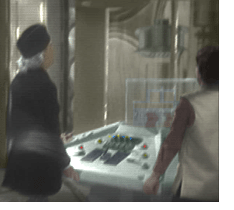
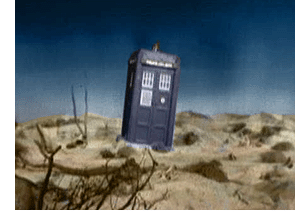
The unbroadcast pilot episode of Doctor Who made in 1963 reached its dramatic climax with the Doctor throwing the controls of his spaceship and the machine was set in motion. For this pilot episode the job of creating this vital found fell to Brian Hodgson at the BBC Radiophonic Workshop and his first dematerialisation of the TARDIS was signified mainly by a series of discordant beeps. Only intermittently, the roaring of that famous front door key comes in, but not in the pattern we are now familiar with. The take off and subsequent landing was one complete event and as the hissing noise died away, the TARDIS had already come to rest on a prehistoric landscape, with no accompanying materialisation sound heard.
It wasn't until this episode was re-shot as part of the An Unearthly Child serial that the complete TARDIS sound effect was formed as we know it. However as with the pilot there was no additional sound to indicate the machine's arrival in the world of the cavemen. In the final episode of this serial, television history was made as the audience viewed the time machine's departure from the outside, simply dissolving into nothing. It was accompanied by the complete TARDIS sound which began with a thud, followed by a series of the famous "vworps", and then a whooshing noise. For the next few stories, as was the norm in the early 60s, the viewer was always inside the TARDIS when it landed.
During the first ever Dalek story, the TARDIS makes an attempt to leave the Dalek homeworld but the Doctor has deliberately sabotaged his own ship. In doing so, it causes the engines to stall, and grind. We hear a slowed-down and echoed dematerialisation sound effect which is inter-cut between the normal take-off sound.
The First Landing
The fifth Doctor Who story boasts several "firsts". The Keys of Marinus shows for the first time the TARDIS landing as viewed from the outside. Its arrival on the glass beach was also the first time a model shot had been used to represent the time machine and it shows us that the materialisation of the TARDIS is completely silent. However, at the end, contrary to what had been established, the the TARDIS takes off at the end completely silently too! It would certainly not be the last time the TARDIS's behaviour was inconsistent.
The rest of season one followed the same pattern. Take-offs were noisy and landings were never seen. That is, until the first episode of The Reign of Terror when, amongst gentle birdsong in a French forest, that the TARDIS slips into existence totally unobtrusively, merely arriving with its gentle hum and flashing light. You can experience this wondrous event via the embedded video link to the right.
The original silent arrival of the TARDIS may come as a surprise to many younger fans, and to those who have only tasted the "classic" series at random, but in the context of the show it does make perfect sense.
The intention of this time machine was to go unnoticed because it was created by a race who wished to observe other species without causing a disturbance. What would be the value of a working chameleon circuit if a new tree appeared in a wood with the screeching of a machine from beyond the stars?
So when did the TARDIS start behaving as we would expect it to today? Well, when season two commenced, the miniature Police Box in The Planet of the Giants was silent in both landing and take off, and the ship comes down on the banks of the river Thames without so much as a whisper in The Dalek Invasion of Earth.
The First Noisy Landing
It was following the opening credits of season two, serial three, episode one, entitled The Powerful Enemy (otherwise known as the start of The Rescue to you and me), the TARDIS fades into existence on the planet Dido, accompanied for the first time during a landing by that wheezing, groaning noise we all know and love. It was this, the eleventh Doctor Who story, which finally created the notion that a sound should be played for the machine arriving.
So what did this landing sound like? Every fan can tell the difference between a dematerialisation and a materialisation, can't they? One starts with a thud and goes up, and the other comes down and ends with a thud. Actually no. There was originally no difference. The TARDIS lands in The Rescue with the same “upward” sound of take-off, albeit without the thud. At the end of this story we see another curiosity as the Doctor and Vikki talk in the glow of the flashing light of the Police Box. It was not a hard and fast rule at this stage that the light was a signal for the TARDIS coming and going.
The next two stories retained the newly-started tradition of having a landing noise. So at this point you might be forgiven for thinking that the pattern was now firmly established. Think again!
The Crusade's opening episode entitled The Lion sees the ship turn up in that staple of Doctor Who landing sites - a forest. And what sound do you think announces this thirteenth materialisation in the programme's history? It's a kind of warbling sound! It was actually the sound of the TARDIS computer first heard in The Daleks, and has never been used before or since for a TARDIS landing! Have a very careful listen in the video clip here for this quiet oddity.
The First Special Landing Sound
Season Two's penultimate adventure was The Chase and it boasted a variety of interesting features.
It showed a time machine other than the TARDIS, one belonging to the Daleks (but we're not interested in that thing's noises) and we see the TARDIS travelling through the vortex for the first time, although it is disappointingly realised via a Police Box model very obviously resting on a studio floor mixed in with some footage of inside a child's kaleidoscope.
Episodes one and two of The Chase feature the old landing sound effect, however episode three brings the next development as the time machine is finally given a distinct materialisation noise. This new effect was the take-off sound played backwards, slightly slower than usual, and faded so that none of the electronic “blobs” are heard at the start.
The video clip here shows the very short version of the new effect from the middle of episode three shows. It is then used for the TARDIS landing on the Mary Celeste and then in episode four, a longer rendition is heard, which is the second part of the video clip above right. Back to the First Effect
It may be no surprise to learn that this new landing noise did not stick, and in the very next story, which featured that naughty Time Meddler, the TARDIS appears in 1066 accompanied by the old take-off version again. Worthy of mention from this story is the fact that we finally see a member of the Doctor's race other than his granddaughter and that this person has his own TARDIS. This was a curious turn of events after the Doctor had proclaimed in the previous story that he had built his TARDIS himself. Perhaps the Doctor was the original architect of all TARDISes!
So season two expanded the world of time machines. We got to see two more, other than the Doctor's, a materialisation sound was used for the first time, and a distinct landing noise created.
However, despite that innovation in The Chase, there was a backwards step, and for the third series and for most of the following year the same sound doubled for take off and landing. One thing to mention about the third season is that in episode ten of The Daleks Master Plane we get the Monk's TARDIS taking off but this is ordinary.
When the Doctor arrives to find that The War Machines are poised to take over London it is interesting that another new edit of the TARDIS noise is used to create a different landing sound. This takes the form of the whooshing part of the normal take off, played backwards to create a descending sound, then mixed with the normal first “vworps” of a take off. Click the video link to enjoy this extravaganza.
With season four under way there was still no consistency to the audio. In The Tenth Planet the TARDIS arrives in the midst of a
snowstorm silently, just like the good old days. Perhaps the blizzard is just supposed to be drowning out the materialisation.
Hartnell departs the show and a Troughton comes in, but not much changes in the time travelling sound-scape. There's little of note in Troughton's first season as the original take-off noise continued to be used for all landings and was particularly noticeable in The Moonbase as on this occasion the landing even began with the “thud”.
A Sick TARDIS
Season five brought a new landing noise – perhaps inadvertently - when the Time Lord faced his doppelgänger. When the TARDIS arrives on a beach, we hear an unexplained slowed down and echoed landing, but still using the take-off effect! This is probably related to the fact that at the climax of The Enemy of the World the TARDIS doors are opened whilst in the vortex, resulting in us hearing the sick-sounding TARDIS noise, which is the same slowed down clip. It seems the malfunction noise it was also inadvertently used for opening of the story.
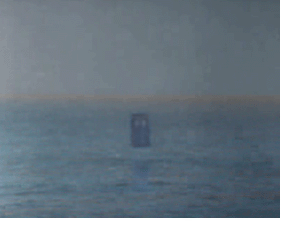
It is Fury from the Deep that we finally get close to the legendary “proper” TARDIS landing noise. The moment is unique because as we heard this proper "downward" sound effect for the first time since The Chase, is the only time in the show when we see the TARDIS float down from the sky and land vertically – and on the ocean too! This new sound effect is the usual take off sound played backwards, looping the last few “vworps” three times over before "thudding" onto the water.
Season Six starts with The Dominators and the TARDIS is once again back to landing with its old take-off noise. At the end of this story the ship is engulfed in lava and the "sick" engine dematerialisation is used again, and also in the following The Invasion as it sluggishly moves from the path of the Cybermen's missile. As the ship comes in to land on Earth, another new malfunction sound crops up, starting with the crackle of electrical energy, joined by a warbling buzz, and a quiet speeded-up version of the “proper” TARDIS landing noise underneath.
The TARDIS's next landing was on a planet ruled by Krotons and it has once again reverted back to the take-off sound for the landing, however it was given a long, echoing lead in. But later in episode three, the normal correct landing sound was used, and it was used again in The Seeds of Death but only heard inside the console room. Then in The Space Pirates it seems to be gaining a foothold as it is used once more. This is still the same looped-over effect that started off in Fury from the Deep, but this time heavily modulated so that it “throbs” in and out. The War Games switched back again to a phased take off sound.
The TARDIS in Exile
It may come as a surprise that even by the time that Jon Pertwee made his début the TARDIS materialisation was not standard because Spearhead from Space reverts back to using a very brief section of the same old take-off sound. The new Doctor also discovers the reality of his exile when he tries to leave and a juddering, unhappy TARDIS emits smoke whilst its usual noise is speeded up and slowed down, all with a stammering effect for good measure.
Due to the Earth-bound nature of much of the Pertwee era, little was seen (or heard) of the TARDIS, although both Ambassadors of Death and Inferno featured mishaps with the console, the former using a brief series of speeded up single "vworps" punctuated with pops, and the latter has a high pitched bit of the take off sound followed by a series of piercing electronic screams and prolonged zaps, and ending with a huge crash.
We near the end of our exploration of TARDIS noises in season eight. In the opening story, Terror of the Autons, two new Time Lords arrive on the scene, one to warn the Doctor about the other. A bowler-hatted man arrives with the looped TARDIS materialization noise, as per Fury from the Deep but ends with a curious pop sound as he suddenly appears. We also get to hear the Master's TARDIS landing, just like the Doctor's.
Claw of Axos featured Jon Pertwee's first flight in the TARDIS along with a rather nasty edited take-off sound which chops out the middle and, for some reason, a snippet of the “thud” from the landing has crept in too!
A Period of Change
Claws of Axos also brings the first full use of the complete, “proper” TARDIS landing. Instead of the looped version which had kicked around since Fury from the Deep, we finally get the perfected “reversed landing”, although it is heard inside the TARDIS, not outside. Despite this there is still another hastily cut-together materialisation sound effect used afterwards.
The Doctor's TARDIS was allowed another outing two stories later in Colony in Space and unsurprisingly some new oddity cropped up. Whilst a fairly ordinary take off and landing sound was used, the Police Box shell disappeared in the blink of an eye, and the sound cut off abruptly. It appeared equally suddenly.
Two stories later and into season nine, Curse of Peladon gets that looped landing out of its system once and for all with a marathon series of loops, contrasting with the next mission of the Doctor's when he went to help The Mutants and used the “proper” landing sound.
The Three Doctors is the end of our journey through the world of sound (aside from a few footnotes) and in this anniversary treat we get a full take-off and full landing in succession, with now (finally) the landing sound effect you would expect. It wasn't until this, the tenth anniversary programme that the full materialisation was heard for the first time which would become the standard.
A Few Extras
Despite an established two sounds for take off and landing, there were a couple of exceptions to this rule. For some bizarre reason, apparently only to show off to the Sisterhood of Karn, the TARDIS takes off at the end of The Brain of Morbius with a speeded up sound and vanishes instantly in a puff of smoke.
It may also be worth chucking in a mention for the Master's TARDIS which is given its own distinctive sound for Anthony Ainley's Doctor with lots of jangling sounds thrown in.
Fast forward nearly a decade and a new TARDIS effect is heard to represent the time machine falling into the Rani's trap in Time and the Rani where we hear a speeded up effect and another decade on and the Eighth Doctor gets a brand new “faulty TARDIS” effect for the TV Movie when it also features a smokey visual effect instead of the normal 'roll back and mix' and also exaggerates the tradition started in Silver Nemesis that a TARDIS landing makes a great deal of wind.
Bizarrely, this sound effect harks back to that one-off warble in The Crusade, but also reverts to using disjointed snatches of the take-off sound. The TARDIS lands perfectly with the “proper” effect at the end. Also worth mentioning is the use of a continuous looped “vworp” heard inside as the ship is in flight.
Our final jump right up to date into the new series which uses the “proper” effects for Rose but continued the use of wind in take off and landing, plus the Police Box became slightly translucent.
Another oddity was at the end of the 2006 story The Runaway Bride in which the TARDIS took off vertically like a rocket, harking back to the landing in Fury from the Deep. This was in the same story where the TARDIS legendarily speeds down a motorway after Donna's taxi.
The sound of the TARDIS is a cultural icon. With the revival of the new series you'd be surprised if there were many people in the country that didn't recognise the sound. And yet our little journey through the archives has shown that the TARDIS didn't even have a landing sound for more than a year after the show started, and the “proper” effect we now take for granted wasn't really in use until the show's tenth anniversary.
Thanks to: Joe Stewart and Michael Seely for corrections.



 The unbroadcast pilot episode of Doctor Who made in 1963 reached its dramatic climax with the Doctor throwing the controls of his spaceship and the machine was set in motion. For this pilot episode the job of creating this vital found fell to Brian Hodgson at the BBC Radiophonic Workshop and his first dematerialisation of the TARDIS was signified mainly by a series of discordant beeps. Only intermittently, the roaring of that famous front door key comes in, but not in the pattern we are now familiar with. The take off and subsequent landing was one complete event and as the hissing noise died away, the TARDIS had already come to rest on a prehistoric landscape, with no accompanying materialisation sound heard.
 It is Fury from the Deep that we finally get close to the legendary “proper” TARDIS landing noise. The moment is unique because as we heard this proper "downward" sound effect for the first time since The Chase, is the only time in the show when we see the TARDIS float down from the sky and land vertically – and on the ocean too! This new sound effect is the usual take off sound played backwards, looping the last few “vworps” three times over before "thudding" onto the water.


