|
|
Home
creative
things
|
 |
| |
|
research and facts
|
|
| |
|
images and misc
|
|
| |
|
archives of long ago
|
|
| |
|
|
Season One - Season Two - Season Three - Season Four - Season Five - Season Six - Season Seven - Season Eight - Season Nine
Season Two - Planet of Giants
Season two gets underway with little suggestion of any change from the first run, and their dialogue even points to having just left their previous adventure in France, so no space for a missing adventure in here!
Perhaps it's with the foreknowledge of the next adventure, but I do find Susan most annoying and I wouldn't mind seeing the back of her really. I don't know if it's her voice, acting character, but she just grates on me. I think the whiney nature of the character is not helped by the fact that she hardly smiles. She seems a very dour sort of person and if she's not actually shrieking, then she's worrying about what she might have to shriek at next.
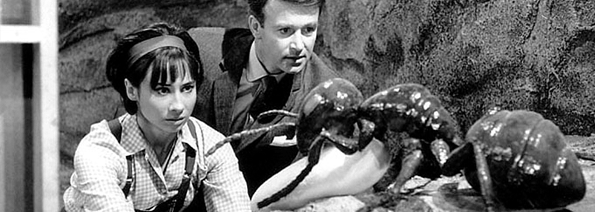
I am struck by how extraordinarily good the sets are for Planet of Giants. Although there are one or two silly moments were people notice something that would have been in plain sight all the time, in the most part the giant surroundings are fantastic, particularly the kitchen sink.
The story is extremely parochial and very unusual for the show in both the number of guest actors and the nature of the story. It is their only adventure on contemporary Earth so far in the programme and yet Ian and Barbara don't seem to dwell on how close they came to getting home. Right place, right time, wrong size! The series is very focused on adventure and it doesn't often stop to give any kind of emotional feedback from the characters aside from what relates to the story.
I don't know whether I noticed it because of my knowledge about the production, but episode three is very jumpy. I happen to know this is because it is two episodes chopped down into one, but the plot does make huge leaps forward which at the time must have seemed relatively pacey, although God knows how long those last two episodes would have seemed unedited.
The Dalek Invasion of Earth
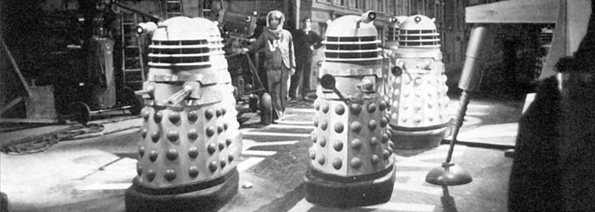
From the point of view of someone watching these stories in order, this story is fascinating. You couldn't imagine a more different adventure to the quirky, pokey Planet of Giants. The first episode is a slow build up, but the reveal of the Daleks is fantastic although as with all modern telly, it was no doubt spoiled by publicity and trailers at the time! The story is a sprawling epic with countless characters and set against a backdrop of a completely destroyed Earth. What a shocking scenario!
Okay so the production values are a little shaky at times, and I don't know what's happened to the Dalek voices, but the ambition of the serial is extraordinary. I can't feel I can say too much else about this adventure which hasn't been said so many times before, except to underline the contrast between the first two stories of the new season. The Dalek Invasion of Earth really was the blockbuster of its day.
Susan's departure (seen from the point of view of today's cynical TV execs) is not surprising. It had been on the cards for a while that Barbara and Susan were surplus to requirements and although accounts of the time differ, it seems that only the Doctor and Ian were seen as vital to the show continuing.
Poor David has only known her five minutes and he doesn't know what he's let herself in for. It's a sombre ending to a sombre story. Although the humans are victorious against the Daleks, it is at a great cost, and leaves feeling quite exhausted.
The Rescue
The Rescue is a fairly light tale. Only a couple of characters are introduced and despite some potentially disturbing undertones regarding the situation, it is a gently diverting story involving murder, lies, emotional blackmail and exploitation.
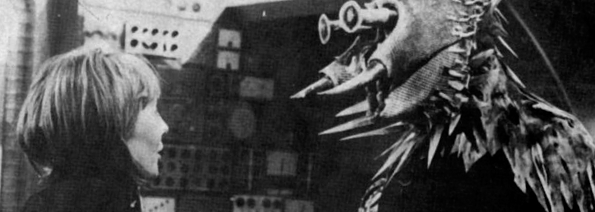
Koquillian is a disturbing creation and with Tristram Carey's disturbing metallic score on top, the whole effect is to create one of the show's more horrific creatures, which therefore makes the revelation that the monster is not for real all the more interesting. It's a mystery as to why the Doctor describes the planet's inhabitants in the style of Koquillian's costume rather than the humanoid appearance which turns up at the end - methinks the writer had not thought up twist at that point.
But nevertheless, a cute tale which introduces the cute Vicki as played by Maureen O'Brien. By flashing a bit of leg in the first few minutes, she achieves what Susan failed to do in the previous two years - provides something for the dads. She is sweet, and fresh and immediately provides a new dynamic for the group as she's both outspoken and vulnerable. A very welcome addition to the crew.
The Romans
What's great about how the Romans starts is how unusual the beginning is. In some ways its a shame because this is the first time a new companion has been introduced, and yet we see nothing of her reaction to the ship or its surroundings. Whilst this might have been interesting, I find it more beneficial that there is no tedious acclimatization and she is immediately just one of the crew. A direct replacement for Susan without the transitional period.
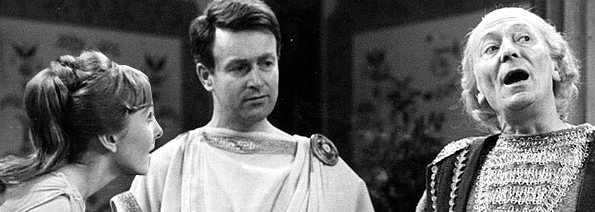
The rest of the story achieves what it sets out to do and is funny, thrilling and a bit daft. I found this story much more fun than I did when I was younger however I still get a pang of relief when I remember that it's only four episodes, when I always think it's going to be six. The fun is over, the TARDIS takes off and get's caught in something which starts to drag it slowly down...
The Web Planet
The Web Planet gives me great joy and I will defend this story against any of its detractors. Some viewers are eager to point out that the planetary backdrops are obviously fake on Vortis, but you never hear the same observation trotted out when people are discussing the merits of The Aztecs which also has painfully obvious two-dimensional scenery. Why is it acceptable to use the wooden rocks on Vortis as ammunition against this ambitious story, whilst people happily gloss over the polystyrene tomb-stone in The Aztecs?
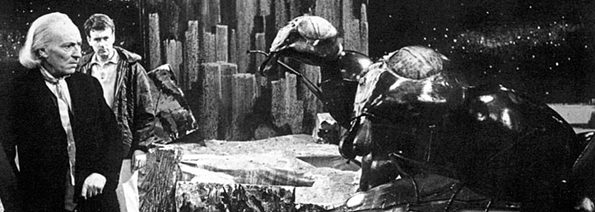
This kind of snobbery is exactly the attitude which keeps the general public from thinking that science fiction is an acceptable brand of mainstream drama. It's easy to poke fun at a man dressed in a giant fibreglass ant costume. It's the obvious thing to do. Finding fault is a very fashionable thing to do in our very media-savvy world. But instead of asking "how did they ever think that costume would work?", people should look past the inadequacies of the design and ask the much deeper questions.
Ludwig Wittgenstein was a philosopher who observed "If a lion could talk, we would not understand him." I am reminded of this quote when we are treated to such poetic delights as one of the Optera saying, "The wall is silent, we must dig with our weapons so that it speaks more light." This is a struggle of oppression between two warring factions of giant insects, and our band of human explorers are caught up in a world unlike anything they've seen before. It's a storyline so fantastic that it deserves to be enjoyed purely as a concept, and it prompts you to consider the values, perceptions and day-to-lives of intelligent aliens who have nothing akin to the technological system we term "civilization."
To draw attention to the technical failings of this story would be unfair due to the scope of the adventure which has a tragically low budget. The Web Planet creates a totally alien world with not one single design-friendly building. The dwellings are gigantic living organisms, or caves, and it makes the prospect of losing the TARDIS in a setting so alien is utterly shocking.
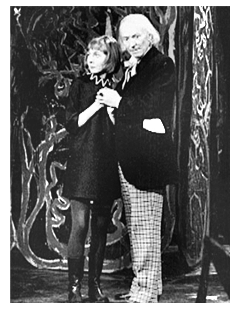 The story is also filled with harrowing moments, such as when one of the Menoptra has her wings ripped off in the Zarbi prison camp - Oppressors have to consider such factors on a world where half the inhabitants can fly. Ian's underground mission to burrow beneath the centre of the parasite invader is very traumatic, as long as you suspend your belief with as much conviction as William Russell plays his scenes. The story is also filled with harrowing moments, such as when one of the Menoptra has her wings ripped off in the Zarbi prison camp - Oppressors have to consider such factors on a world where half the inhabitants can fly. Ian's underground mission to burrow beneath the centre of the parasite invader is very traumatic, as long as you suspend your belief with as much conviction as William Russell plays his scenes.
There are people who say that you can't be gripped by a story without humanoid protagonists. These people are wrong. Are the first two episodes of The Daleks rubbish because the Thals are yet to arrive? No. They're excellent because the lack of humanoids makes the world of the Daleks all the more fascinating. The four-strong TARDIS crew are all the viewer needs to latch on to and their involvement in the plight of the insect world is enough to keep me interested.
Vicki has slipped seamlessly into the role of Susan but the Doctor seems far more protective of this sweet little newcomer than he ever was of his own flesh and blood. Interesting, but hardly surprising!
Our heroes all save the day - converging in an almost identical scenario as the aforementioned Dalek story - in order to defeat the evil menace in a slightly unclear manner, much as in that same Dalek adventure. Once all is wrapped up, there is a very curious but heart-warming final scene as the Zarbi play and their larvae squirt water. The grateful survivors of the Animum rejoice as the time-travelers leave.
I like The Web Planet. So there.
The Crusade
Back to Earth following amazing alien escapades, and we've landed in a forest. I have an interest in history, but the precise ins and outs of Richard III's jaunt to the Holy Land is something I'm a little sketchy on. I happen to know that the first chequing system was devised for rich nobelmen who wanted to cross the bandit-ridden territory whilst going off to fight, and the Knights Templar formed part of the "bank" which allowed them to recoup their wealth from a stash when they arrived, based on a certificate which said how wealthy they were. Clever, eh?
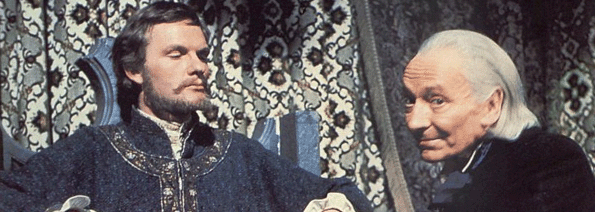
But that aside, I'm struggling really. Learning about the relationship between the English King and his Muslim Counterpart is fascinating. The dialogue is absolutely superb and the discussion about warmongers and speakers in episode four verges on the Shakespearian. Most impressive and enjoyable fare.
It's a fantastic experience watching in order, I must say. You get a totally different complexion on things. And its lovely when the continuity ties in. After watching The Dalek Invasion of Earth, The Rescue, The Romans and The Web Planet, in the story The Crusade Barbara is asked where she comes from. She replies that she's from a world ruled by insects, and before that she was from the time of Nero and before that in Earth's far future. its really nice to hear their recent adventures all mentioned in one sentence.
King Richard puts me in mind of Marco Polo in his relationship with the main characters and I enjoyed this story but I can't think of a great deal to say about it. Following this historical, I'd hazard a guess that the next trip will take us into the realms of futuristic spaceyness. Sure enough, our heroes' next journey takes us to...
The Space Museum
I have mixed feelings about this story. It opens with magnificent promise and a chilling idea. Something has gone wrong with the TARDIS and somehow the time travelers haven't fully arrived in this new location. They are not leaving any footprints, and no-one can hear them. It's a chilling idea and the horror reaches a crescendo when The Doctor and company find their future selves trapped in a glass case on display in this space museum.
I have mixed feelings about Vicki too. She is attractive and lively, and yet doesn't seem to entirely take the situation seriously. Whether this is the deliberate direction of the series or her acting style, I'm not sure but somehow she undermines a lot of the potential tension in the situation. Nevertheless The Space Museum's opening episodes provides one of the most impressive concepts of the series so far.
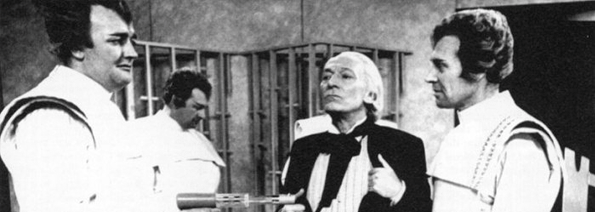
Sadly however, this doesn't come to fruition, as the past/future conflict is just kind of skimmed over as their future versions in the glass case vanish and they "arrive". The way this scene is shot, and the incidental music combine to be impressively cinematic and it is tremendously effective in terms of style, but what we're seeing isn't really in keeping with what I've been expecting. I thought that in some manner the main characters would be found to arrive a second time, and they would go through the process which would cause them to create their footprints and so on. Maybe that's not important.
A nice aside in the midst of this story is a Dalek, appearing as nothing more than a museum exhibit, and not for the first time provides a disguise for one of the main characters.
But as the episodes wear on, there's not a great deal to offer other than fairly standard political fare with a military coup staged and everyone lives happily ever after. Even more so than The Sensorites, the strain of writing something with a science fiction basis seems to take its toll on the writer. Gone is the Shakespearean quality dialogue and in return we have quite a few cliches. Nevertheless good fun, but it doesn't live up to the promise it showed at first.
The story ends with the Doctor stealing a large piece of gear from the museum and lugging it into the TARDIS. To reflect our heroes' new technology (although they don't yet know what it does) we the viewer are afforded a view of something unrelated to the current story and the shocking reveal is that the Doctor's old enemy, The Daleks are plotting to follow the TARDIS and exterminate them! A shocking ending to a story which had earlier teased us with the impotent shell of a Dalek.
The Chase
Watching these stories in order is really interesting because your opinion totally changes on stories when you view them in context. The last few stories have alternated: Future, Past, Future, Past, Future quite rigidly. So whereas I used to slag off The Chase for being cheap and awful, suddenly I find it a breath of fresh air. It's a really exciting blend of clips (Shakespeare, Beatles, etc) and different locations, and comedy and drama. I have to say, The Chase is amazing!
We learnt lots of interesting things in this adventure, the most significantly being that the Doctor built the TARDIS himself. Therefore establishing that he might just be a mad inventor amongst his own people - a pioneer as he once said before. Combined with the fact that Susan once said she made up the name TARDIS herself, this clearly suggests that TARDISes are not commonplace.
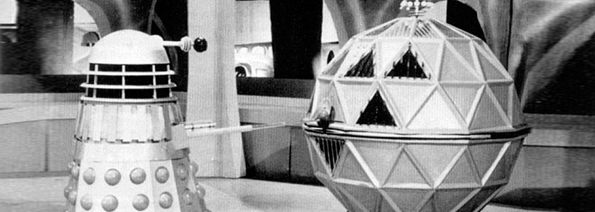
The Chase is like the end-of-season finale of its time, cramming in loads of characters, planets, ideas, special effects, and of course bringing back the popular Daleks. To have a chase through time is very dramatic and the idea of time travel is not usually explored in the show. The final battle with the Mechanoids is extremely impressively put together (save for a couple of cartoon explosions) and the whole story feels like an extravaganza of action!
Around this battle ground we meet a new character of Steven. A rather brash young man with a big chin. He shows a bit of promise but then kind of disappears at the end of the episode without us finding out his fate.
This blockbuster of its kind is a fitting send-off for Ian and Barbara. It's a touching end, but what's quirky is the fact that they never really say their goodbyes to the Doctor properly. It's all done off-screen. Their arrival back on Earth is really sweet but when they find they're two years out, they brush this problem off very easily! Just as they ignored any implications of leaving their lives without explanation, they have also ignored the implications of returning after two years missing!
As these characters leave, I find myself thinking about how little I really knew about them as people.
The Time Meddler
9th October 2007
The final story of season two begins with such stark contrast to the previous story it's quite remarkable. For the last six episodes we had nothing but murder, explosions, robots, running and excitement. Whereas the first episode of The Time Meddler finds the TARDIS in the tranquility of an English shoreline not far from a forest! All is peaceful.. but not for long!
Steven takes to his new life rather easily. He is sceptical of the TARDIS but let's not forget he's been a prisoner of robots on a jungle planet for years and doesn't seem too bothered about his freedom!
The Time Meddler is so different and interesting. A story never seen before where the Doctor turns up in a place, knowing how things should be, and is there to protect the natives from his business - rogue time travelling. Ordinarily he would just be helping against the normal struggles of oppression, and something like The Crusade has little to distinguish it from The Space Museum, with the exception that in the latter there is a satisfactory resolution. This time, we know what should happen in historical terms, and someone else is there to interfere.
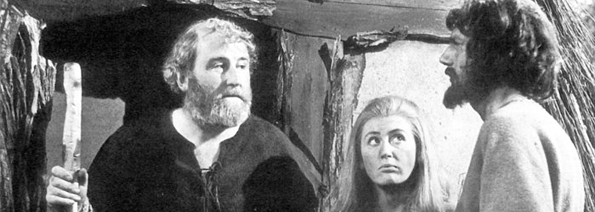
With one less companion, and two experienced ones gone, the Doctor is more pro-active and more in control of the situation. There is no Ian to rely on, the man who would normally shout "Doctor, I've got it!" and solve all their problems.
This story has so much going for it, it's quite mind-blowing. We learn that other members of the Doctor's (unknown) race are wander around and our hero is not unique. Quite amazingly, this goes against the fact we learnt in the previous show that the Doctor built his TARDIS, because The Monk has his own. Unless maybe the Doctor built all TARDISes?
Following this wonderfully peaceful and revelatory tale, the second season ends with the final shot reaffirming the three regular cast members with their faces in the stars, echoing the Doctor's final words from the previous season - that their destiny is in the stars.
Season One - Season Two - Season Three - Season Four - Season Five - Season Six - Season Seven - Season Eight - Season Nine |
|
         |