Season One - Season Two - Season Three - Season Four - Season Five - Season Six - Season Seven - Season Eight - Season Nine
An Unearthly Child
Doctor Who begins. Curious, well-written and well-acted. I won't say too much about how good the opening episode is, because so much has been written on the subject before, but the four episodes, regardless of how thrilling you find cavemen, is a high quality start.

Lots of care is taken in the characterisation and everyone is so clearly defined so quickly including a very brutal Doctor, who at one point is on the verge of smashing a defenseless man's head in with a rock.
I do find it odd that we never quite get a handle on whether or not the cavemen and our heroes are speaking the same language. They seem to understand each other but I suppose whatever mechanism allows them to talk to each other in the same tongue is hindered by the unsophisticated caveman brains. That aside, a great deal of thought has clearly gone in to every aspect of this bit of television.
The Daleks
The care shown is carried over into The Daleks and following the narrow escape from the Cavemen, we plunge headlong into the problems faced by another planet, and for that to happen so soon feels quite exhausting.
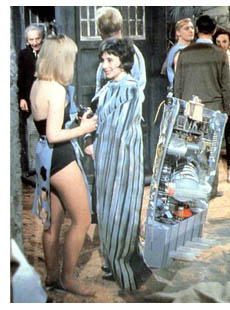 The time taken to explore the world of the Daleks is very important. Despite the story being slow, I wouldn't feel it was realistic to rush the acclimatisation of the human characters to a new planet. This isn't Star Trek where exploring planets is an everyday activity. This is a situation where two unremarkable teachers from an unremarkable school are "violently uprooted" as they put it themselves, and suddenly they're feeling the alien breeze on their faces. I don't think such a concept has been so carefully highlighted in science fiction as it is in the first episode of The Daleks. The time taken to explore the world of the Daleks is very important. Despite the story being slow, I wouldn't feel it was realistic to rush the acclimatisation of the human characters to a new planet. This isn't Star Trek where exploring planets is an everyday activity. This is a situation where two unremarkable teachers from an unremarkable school are "violently uprooted" as they put it themselves, and suddenly they're feeling the alien breeze on their faces. I don't think such a concept has been so carefully highlighted in science fiction as it is in the first episode of The Daleks.
After we meet the brilliant Daleks (about which a lot has been written before) the story becomes electrifying. It has Flash Gordon themes, done with the care of a crime drama. I think this must have been quite shocking in 1963. Quatermass paved the way in doing serious television sci-fi and departed from the comic-book style, but the sheer weirdness of the Daleks, and meeting them on their own terms, as human intruders in their city, must have been utterly compelling.
In terms of pace, The Daleks does goes odd around episode five and the plot seems to come off the rails a little. For instance, one minute the Daleks discover that taking an anti-radiation drug acts like poison, but then somehow this poison becomes an airborne disease and the "infection" spreads from isolated test subjects into the control room without explanation.
There is loads of padding in the caves but even this still has its plus side as it brings a very epic adventure feel to the proceedings.
I also find it interesting how much we learn about the supposedly mysterious Doctor compared to the other characters. We've already learnt that if he had all the right data he could control the ship, and only a hasty take-off prevented him from steering the ship better. He also now says he was a pioneer amongst his own people. We already know more about this old man's past than we do about the humans in the show. I feel I know the teachers characters quite well, but aside from bacon and eggs, what interests do Ian and Barbara have? Did they have family at home who will miss them? How did they end up as teachers? Are they friends with each other outside of school? It's quite surprising how little information we're given on them considering how much time these stories have to fill.
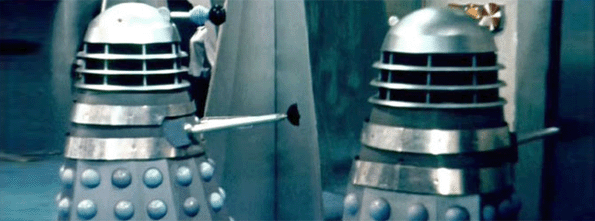
But back to the story and the defeat of the Daleks isn't really a defeat as such. Their end is brought about in a rather uncertain manner. Ian says they've knocked out their power but I'm not wholly clear how this was accomplished as the human and Thal plan didn't seem to have any particular objective other than to get into the city. Nevertheless a bold story with a dramatic conclusion and a sweet ending as the Doctor says he might come back and visit the Thals' grandchildren.
Strangely, the TARDIS control room at the end of The Daleks is tiny but following an explosion and a roll of the credits, we join the first episode of the Edge of Destruction with an absolutely massive version of the console room. And also one not entirely dominated by roundels.
The Edge of Destruction
Interestingly we get more info on the the Doctor and Susan as they seem to be repeating a past argument and he insists they cant go back to their homeworld. Curiouser and curiouser.
Another lovely snippet is hearing about Planet Quinnis from four or five journeys ago. If the current story may be journey #1, then the previous one to Skaro was #2, the Cavemen world was #3 and the first episode was #4, so presumably Quinnis was the very last place the TARDIS visited before visiting London in 1963. Therefore also presumably the last place the camouflage system worked! Not important, but really fascinating. What happened to them on Quinnis? What form did the TARDIS take there? Was the ship damaged at that point and therefore stop for repairs in 1963?
The Edge of Destruction is eerie, but slow. It is disjointed and deliberately unsettling but it is let down by some dodgy acting and you never quite know where it's going. It is also remarkably vicious and tough but all of this is undermined by the utterly ludicrous ending.
The concept that this magnificent time machine relies on spring switches is laughable but the way it is then explained to Susan as if she was ten, rather than the product of a time traveling civilization is astonishing.
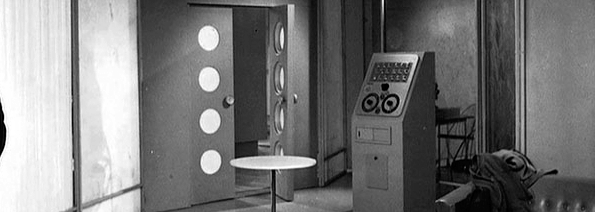
Susan is also extremely annoying both in the delivery of her lines and in her attitude and I would not be sorry to see her go. Her acting, unlike the others, smacks of children's TV and she does very weird things with her shoulders.
This story is the most we learn about the crew in one go, but also the biggest departure from the established characterisations. I accept that we saw the Doctor ready to kill a caveman with a rock, but I am still left bemused by his behaviour towards the others since they've been through the previous ten episodes of life and death together. If this was Adventure One then maybe I'd believe the nasty threats and insults, but not in Adventure Three, however with all the strange goings-on I'm never sure how much of the odd behaviour I'm supposed to attribute to the TARDIS's influence. Very odd.
My overwhelming impression from these opening three stories is one of futility and trauma, with the deaths of all four characters literally seconds away at the climax of each of the three stories. The Edge of Destruction goes a step further to have the Doctor tell Ian how he's trying ensure the girls imminent deaths are as easy as possible. Not exactly comfortable viewing!
However, as with The Daleks, The Edge of Destruction ends on a very tender note and you'd forgive the Doctor almost anything. He is so warm and charming when he talks to Barbara at the end that you find yourself really growing to love this pain in the arse of a man.
Marco Polo
Marco Polo is a lovely adventure, well written and epic but like all these early stories its pretty grim and there's no hammy acting to take the edge off the stress of their predicament or the confrontations. There really is the sense of peril at every turn.
Very like The Daleks this adventure has a sprawling feel, but with more depth to the people they meet. I never quite know how to take the character of Marco as he clearly means them no harm, and yet keeps them on a metaphorical chain.
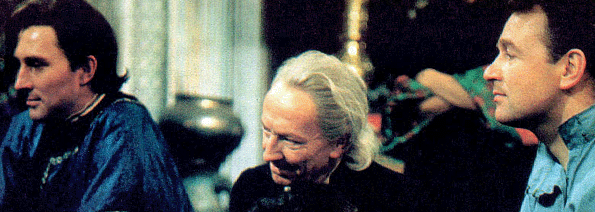
Their struggle over possession of the TARDIS is interesting as this is already the second time in the show that the machine has been the object of desire of another party, and again the travelers are quick to reveal the truth about their ship to a disbelieving adversary.
At least Marco Polo ends happily with very little mortal danger unlike the previous stories and it also finishes with a wonderful little reminder of the potential of the series as Marco reflects on whether the travelers will next visit the past of the future.
The Keys of Marinus
18th August 2007
The Keys of Marinus is indeed futuristic but suddenly the series has been jerked back a step in terms of quality. Where has the subtle dialogue and good acting gone? Hartnell is heading for a world record number of line-fluffs in the opening ten minutes, not only forgetting what the words should be, but spouting his own hilarious interpretation of the script.
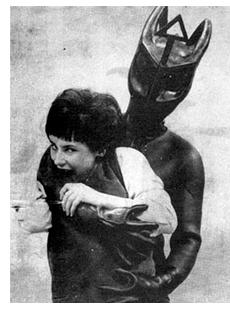 From the stunning sets of Cathay in the previous story, we now arrive on a cardboard island which prompts stupid observations and exclamations galore from the characters. I find a great deal of it is unintentionally funny and this is real B-movie stuff for the first time in the series. Weird wetsuited monsters are just a baffling addition after the panache of the previous, very believable historical story. From the stunning sets of Cathay in the previous story, we now arrive on a cardboard island which prompts stupid observations and exclamations galore from the characters. I find a great deal of it is unintentionally funny and this is real B-movie stuff for the first time in the series. Weird wetsuited monsters are just a baffling addition after the panache of the previous, very believable historical story.
The director of The Keys of Marinus seems to have little skill in making the characters relate to the sets, and they frequently notice things which must have been in plain sight all the time.
Along with the bad production is a terribly childish script by Terry Nation. There are awfully crowbared lines about historical building techniques as if he's just remembered he should be educating children as he goes. He also shamelessly tries to recapture his success of The Daleks by recycling the ideas about exploring a new planet and its mysterious city. His last planet was a "scarred" world called "Skaro" and this time its a "marine" world called "Marinus" - His creativity knows no beginnings.
We're treated to pantomime swivel walls, comedy screams from falling Voord, laughable dialogue, and it all adds up to a really cheap and disappointing first episode after the quality of everything that has gone before. Most of the blame lies at the feet of Nation whose unsubtle script is clumsy and illogical. It sets up an interesting premise for the story but nothing about makes any sense.
Another snippet about the ship is thrown in but this time we learn there is fault in the time mechanism. Wasn't it said before that the Doctor just needed the right data in order to fly this ship? Maybe that was a bluff and the truth is out now?
In its story-within-a-story format, the pace is kept up quite well and I like how every episode is self-contained but the challenge of so many settings and characters within six episodes is presumably what takes its toll on the production which is so cheap and sloppy. A world apart from Marco Polo.
I find it fascinating to see how the film The Matrix is based entirely on episode two, The Velvet Web. The plot of both is along these lines: We find an apparently perfect civilization living happily, until one of the protagonists discovers that the world is in fact an illusion designed to keep the humans there enslaved. An alien race has infiltrated and taken control in order to exploit the versatility of the human body. Once released from the illusion, one lead character must try to hide-out in the "real" world - a place of squalour and degradation, to find others who might help her bring down the fantasy world.
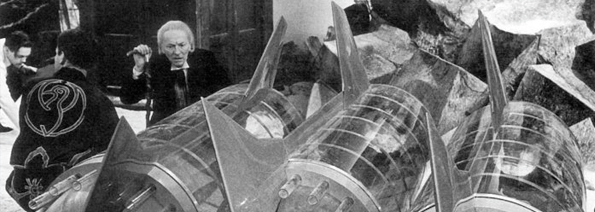
In the Doctor Who version, Barabara does this by hitting the desk next to a bell jar and making an alien cry. Okay, so it isn't quite the same spectacular Kung-Fu climax as seen in The Matrix but the rest is pretty familiar, no? In fact they even go so far as to play on the name Morpheus in the story.
We learn that the Doctor has met Pyrrho, the originator of sceptisicm. Yet another adventure we haven't seen. How long did the Doctor travel around after leaving their homeworld, and before he lands on Earth with Susan?
The Aztecs
I'm struck by how non-sexual Ian is. I don't intend that to be an insult to the character or the actor, but he just seems very "safe." Despite it being often talked about in articles and spinoff fiction, I find there is absolutely zero romantic tension between Ian and Barabara. Not one look, not a touch or a word uttered that makes me think these two are hiding their true feelings and should run away together. They just seem like to very safe child-friendly teachers. Friends on a professional level and nothing more.
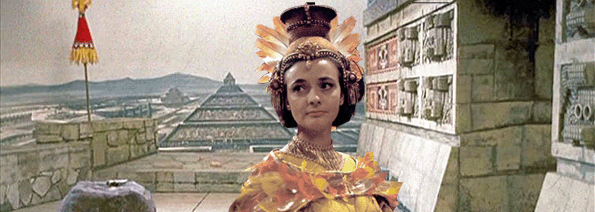
Speaking of teaching, The Aztecs suddenly and rather clumsily reminds us that Barbara was a teacher, and she rattles off some knowledge on her specialist subject - the Aztecs. This is yet again one of very few snippets of information we glean about the human characters in this programme. We still know nothing of their backgrounds, friends or family, and you suspect we never will.
Susan continues to be irritating. Her character is like that of a juvenile human, and not the unearthly genius we were first introduced to. Her exclamation of "ooh look, cartoons!" upon seeing the Aztec artwork is more than a little moronic. Thankfully this is one of the few bad things you say about this story as it enjoys a sparkling script and wonderful characters. It is the most mature story so far.
The Sensorites
We are then thrown back into the future with The Sensorites and our travelers land on a spaceship. It is in fact the first spaceship ever in Doctor Who. It's odd though that as soon as the period adventures get left behind, so does the great script. The Sensorites isn't a bad story by any means but why can't we have the delightful dialogue of The Aztecs in a futuristic setting? It's as if the strain of writing about futuristic concepts absorbs all of a writer's brain-power and therefore ordinary conversations become a strain. I suppose it's this idea that everyone in the past was eloquent and wordy, because our historical reference points are the likes of Shakespeare - i.e. pseudo-historical documents which have only become famous because they are so well written.
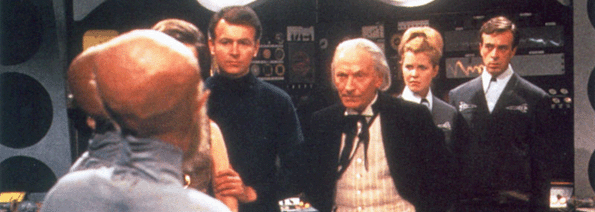
We learn some fascinating facts: We find out that Susan is genuinely quite young because the Doctor compares her to one of the humans, Carole. Now, you might just be able to argue that maybe Susan has regenerated, and since taking the form of a young girl, the Doctor has come to think of her that way - However he also says in this story that they have been travelling together for years. So their escape from their homeworld has been pretty recent, not really long enough for any regenerations or adjustments, so it looks like Susan really was born about fifteen years ago. What could possibly have happened to her parents, the Doctor's children, in order that their only course of action was to leave together?
What is lovely is that we get to find out a little about this world from which they escaped. Susan and the Doctor's home is quite like Earth, but the night sky is a burnt orange colour and the tree leaves are bright silver. Susan it seems is telepathic to some extent, although as the Doctor is not, this doesn't seem to be natural amongst their people.
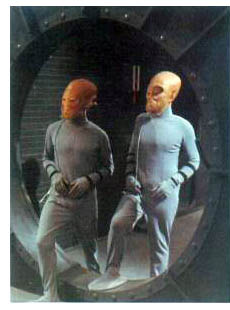 The Sensorites is the third attempt at a future-story and in many ways it is the best. It is well-structured and has a core of human characters with whom to side, as well as a mystery to solve, some interesting science fiction concepts and a compelling alien civilization to get to know. This truly is what makes the Doctor Who series so great, and I don't believe that The Sensorites gets the recognition it deserves. The Sensorites is the third attempt at a future-story and in many ways it is the best. It is well-structured and has a core of human characters with whom to side, as well as a mystery to solve, some interesting science fiction concepts and a compelling alien civilization to get to know. This truly is what makes the Doctor Who series so great, and I don't believe that The Sensorites gets the recognition it deserves.
I think part of the reason it is under-appreciated is because we no longer view it in context - it will be seen by most fans as a self-contained piece of television reviewed on its own merits when released on video or seen on satellite TV. But instead it should be appraised as part of the first season, without losing sight of how early it is in Doctor Who history. It is the story which brought us the first believable alien culture, the first space-ship and the first glimpse of how the human race fares in the future. The early episodes are also our first taster of the base-under-seige format of the show which works extremely well.
What I also love is that in episode one of this story the travelers reflect on their recent adventures together, thinking back over places they have landed. It is particularly rewarding to someone watching these stories in order as it acts as a little recap of things I've seen recently and it makes everything gel together and underlines their progress as a team. What I wasn't especially keen on was the extraordinary sudden change of tone at the end of episode six where the Doctor has a hissy fit and decides to throw both Ian and Barbara off the ship immediately!
The Reign of Terror
25th August 2007
This tantrum is carried over into the follow episode and the argument continues over whether they have landed where the Doctor said they would. A further joy of watching stories in order is how the adventures blend together, carrying over conversations, questions and costumes from one story into the next. In this instance, Ian's charms win the Doctor over, but if they really are on contemporary earth, then they will still be going their separate ways. The suggestion of saying goodbyes over a drink sounds really sweet.
Part of the above debate is tangled up in the fact that the Doctor does seem to genuinely believe he has total control over the TARDIS aside from a couple of faults which have come and gone. In an earlier story he has said that he just needs the right data in order to steer the ship, but then later he said there was a fault in the time mechanism. How much is bluff and bluster? Does he not want to take these humans home? Can he actually steer his ship, more or less? Has he given the game away in his argument with Ian that he has really been holding them hostage?
In one of the very few snippets of the teachers' past lives, we learn that Barbara once took a holiday in Somerset! Not exactly in-depth character study, but there you have it.
The Doctor's ring is mentioned I'm sure for the first time, and although its actual significance is never made clear, it is clearly important to him.
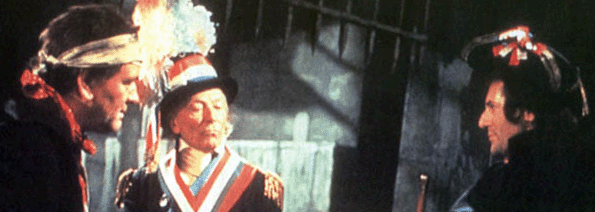
The Reign of Terror is a bit slow but it is the most fun story so far. The script is light and clever with lots of little nuisances about the politics of the period which would be lost on most people - myself included, had I not read up on the period during a recent visit to Paris. There is a new sort of whimsy to the proceedings, one which hadn't been present in any previous adventure, and despite the grim nature of the events depicted, there are some very funny moments such as when the Doctor inadvertently talks himself into becoming slave labour, and then uses his intelligent trickery to get himself out of it again.
The story does drag as it reaches the middle chapter and the different character threads become rather confusing unless you're paying complete attention which, I have to confess, I wasn't towards the end. The upshot became clear in the end though as it tied up with historical events that I actually understood and it was very interesting to see Doctor Who's first famous moment in time visited. Despite all going on around them, the heroes escape with relatively little jeopardy. Their flight from danger is a relatively comfortable horse ride through the country, and then cross fade to them being back in the TARDIS.
It's interesting, after what I said following the early three adventures in which the heroes only just escape with their lives on four occasions, that the level of threat was toned down somewhat as the show went on. Although The Aztecs was a close-run thing, you never felt in The Sensorites or The Reign of Terror that everyone's death was just around the corner.
The episode and the season ends with some deliberate poignancy as the Doctor reflects on their destiny being in the stars.
Season One - Season Two - Season Three - Season Four - Season Five - Season Six - Season Seven - Season Eight - Season Nine |